
What does Project Peru do in Peru?
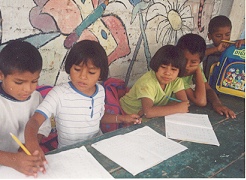
The focal point of the Project in Peru is at Zapallal near Lima, where we have established a children’s refuge. We provide food, clothes, shelter, education, health and fun for children and families from extreme poverty. We also distribute a variety of material goods sent from the UK, both in the refuge, to the families, the immediate community and periodically in the interior of Peru. We are virtually the sole source of funds for Project Peru in Peru.
What does Project Peru do in the UK?
We raise funds and send financial support to Peru; we also send material assistance (including clothing, educational materials, toys, toiletries) for distribution to our refuge and elsewhere in Peru through the project’s network of contacts in Lima and elsewhere in the country. We raise awareness in the UK about Latin America in general, about Peru in particular, and especially about Project Peru.
How did it all start?
The organisation’s principal objective is to offer practical, ongoing and desperately needed help to those who live in extreme poverty in the desert shanty towns of Lima, and to raise awareness of the real issues facing Peru and Latin America in general. Project Peru evolved over a number of years through the voluntary activity of a group of people in Guildford who had been concerned with raising awareness about Latin America. Project Peru became a registered charity in 1995 (Registered Charity Number 1049413).
Who provides the money?
Almost all of the money needed to run our refuge in Peru and all our other activities is generated from the UK through voluntary effort. There are no paid staff in the UK and overheads are minimal at around 4% on an average annual income of around £100,000. Project Peru’s fundraising activities include events and sponsored activities, craft sales, contributions by volunteers going to Peru, workshops in schools and public speaking. Individual supporters frequently organise their own fundraising activities or make regular or single donations, where appropriate utilising Gift Aid.
What does the money provide?
The money provides funds to pay staff, to maintain a residential children’s refuge and appropriate services for about 50 children and young adults who are unable to live with their families; and to provide funds to construct and maintain appropriate buildings, and to develop supportive programmes in the community outside the refuge.
Where do the children come from?
They come from a variety of backgrounds and environments and are identified as children at risk; they come not only from extreme poverty but from family or social situations where they are unable to live at home, though they are in almost all cases not orphans. New clients are referred both by word of mouth and through referrals from appropriate services in the vicinity of the refuge, or from further afield. Some are spontaneous or emergency cases. They can be longer-term residents, but others we help on a temporary or transitional basis. The criteria we use is that they are at great physical or moral risk and that we have assessed them as such.
What about their families?
We keep in close touch with the relatives and the children stay with them from time to time. They visit the refuge where we have developed programmes of social and educational support including workshops with our psychologist. Their family members come to help with cleaning or cooking or offer other skills they may have, giving them a sense of dignity and sharing.
Are they street children?
The children are not specifically ‘street children’ in the current popular understanding of the phrase, though some may be, and some might be if we did not help. Many do have relatives who for different reasons cannot care for them or pay for them to go to state schools, hence they risk being on the streets. Many come from dysfunctional families but only a very few have no relatives.
What happens about their education?
All the children at the refuge go to the ‘El Dorado’ School, the neighbouring State school – attending either for the morning or the afternoon sessions depending on their age – and have been supported by Project Peru in the purchase or provision of educational materials, buying school uniforms, paying the obligatory annual matriculation fee for each child. This is a considerable expense at the start of each school year in March. We give the children additional educational support by employing teachers to do educational support work with us, and by keeping close links with the school through our education support staff and our librarian.
What happens when the children grow older?
We have developed new buildings to enable the children to learn to live more independently while they are with us, and are seeking funds to enable us to have a halfway / student house for the young people, as they become adults. We ensure that the older children are trained in their preferred career by supporting them when they leave school, through further education, training and work opportunities in the world outside. In several cases Project Peru pays for this further and focused education, some stay on living in our refuge while studying, and several have now gone on to study at universities.
Who works at the project in Peru?
We have created paid employment for a full time director who is also a qualified social worker, an administrator, full time house-parents, a librarian, a cook, a part-time psychologist, staff responsible for housekeeping and laundry, carpentry and maintenance, gardeners, and a number of support teachers for both academic subjects and for music, dance, sport, hairdressing, theatre and dressmaking. All our staff are Peruvian, predominantly from the local community.
Is Peru / Latin America really so poor that it needs this type of help?
As a middle income country, Peru is not the recipient of debt relief or of aid, and therefore, compared to Africa, does not appear to be so poor. To take just one example, all UK aid to Peru was stopped in 2004 and switched to support reconstruction work in Iraq. But Latin America has the biggest income gulf between rich and poor of all continents in the world, with many people living in extreme poverty. Peru’s economy may be getting stronger in parts but not in the parts we reach!
What does Project Peru’s logo signify?
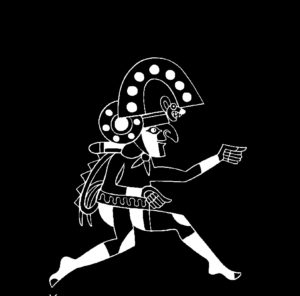
Project Peru’s logo shows a ‘chasqui’ runner, a design derived from Mochica pottery. As did the Incas later, the Mochica people used these ‘chasquis’ as relay runners to deliver messages and goods throughout Peru. The Moche or Mochica culture prevailed in the northern coastal region of Peru from about AD100 to AD800. Project Peru continues to carry support, friendship, education and goods to those in extreme poverty, from the shanty towns to the sierra.
How can I help Project Peru?
- make single donations – but regular monthly ones give us much more long term security
- organise a fundraising event for us
- sell our Peruvian crafts
- invite us to work in schools with which you are involved
- put us in touch with potential volunteers, or volunteer yourself
- give us ongoing support after a trip to Peru, or before
- walk the Inca Trail or undertake other challenges
- contact us with your ideas and skills
Where can I find out more about Project Peru?
Email: information@projectperu.org.uk or telephone: 00 44 [0]1483 576093